Spatial Intelligence: A Pilot Workshop
Nov 1, 2026 · @Gökhan
Before words, there was space
Long before we had words, we had space. Before language, there was the path, the edge of the clearing, the shelter against the rock, the view from the ridge. We, as human beings with a brain shaped over two million years of the genus Homo, the same brain we still use today, learned the world by moving through it, and our minds were built on that movement.
We still speak this way without noticing how space inflects our communication and expression of knowledge. Our language is loaded with spatial concepts. We grasp an idea. We set a problem aside. We look ahead, we step back, we see the bigger picture. Thought, it turns out, has never left the body or the room it stands in or the primal landscapes humans inhabited.
From Smithson to Anatolia
My work on spatiality began at Columbia University, in the Department of Art History and Archaeology in the 1990s. My Master's thesis on Robert Smithson, written with my advisor Prof. Rosalind Krauss, looked in particular at Smithson's Hotel Palenque, the slide lecture in which he walked architecture students through a ramshackle hotel in Mexico that seemed to be under construction and falling apart at the same time, yet evidenced the deep symbolism of the Maya in the Yucatán. It was my first sustained encounter with how site, ruin and space shape meaning. That question carried me through my PhD at Columbia. It is a happy coincidence that the leading thinker on spatial intelligence today, Prof. Barbara Tversky, whose research on spatial thinking now grounds so much of the workshop I am presenting here, is a professor at Columbia too.
Here in Türkiye, I have been able to look first-hand at patterns of human settlement dating back to the Neolithic period and even earlier. Discoveries throughout Türkiye in the last ten years show how archaeology has taken the question further back in time. Working with Bronze Age settlement patterns in Anatolia, my specific interest, I saw how Bronze Age peoples such as the Hittites and Luwians organised space long before the classical canon we were taught as the beginning of architecture. River networks, fortified citadels and höyük mounds rising layer upon layer over centuries of settlement. Out of this came a concept I call Archaeotecture, the idea that the settlement culture of Anatolia's Stone, Bronze and Iron Ages is architectural knowledge in its own right. Architecture education gains a great deal by learning from it, beyond the Greco-Roman models that have long defined where architecture supposedly begins.
Over the years this thread has run through everything I do, from structural stone to environmental graphics at Emedya Design and in biophilic design, to the biophilic park and wall we designed at Piyalepaşa in Istanbul with colleagues such as PIN, mimaristudio and Nilüfer Kozikoğlu of Tuşpa. Along with my extensive work there on wayfinding design, with Gözde Kavalcı Eren at my studio Emedya Design, the Piyalepaşa project taught me the same lesson in a different material. People read space with their whole body, long before they read a sign.
Recently I have been taking this work somewhere new, into design studios and into business. The question I keep coming back to is simple. If we think with space, how can we use that deliberately, in the way we design places, make decisions and work together?
What is spatial intelligence?
Spatial intelligence is the ability to think with space. In architecture, we have long ignored the biological, and hence the psychological, despite the efforts of architects trained in environmental psychology. The cognitive psychologist Barbara Tversky has been a revelation for me. In her book Mind in Motion, she makes a striking case that spatial thinking is the foundation of all thought, and that abstract thinking is built on top of it. By her estimate, about half of the cortex supports spatial thinking.
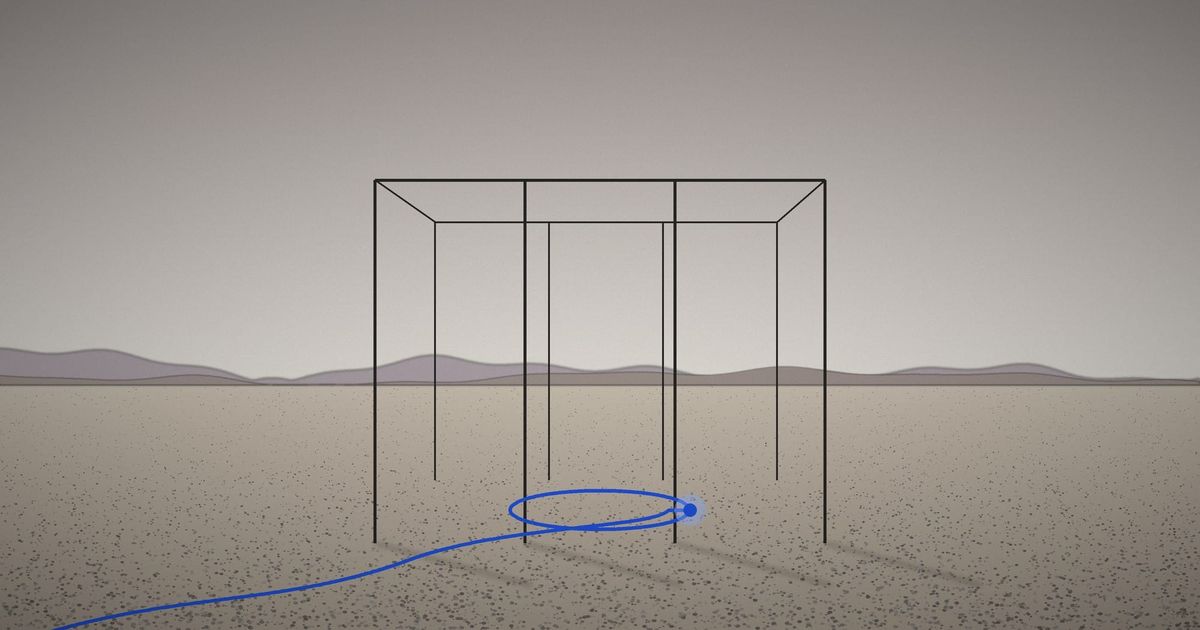
I find it useful to picture it as a loop. We perceive a space. We move through it. Then we put our thoughts back into the world, as a gesture, a sketch, a map, a diagram on a wall. And we perceive that again, and each turn sharpens the thought. Architects know this loop intimately. You draw for one reason, look back at the drawing, and suddenly see something you never meant to draw.
The loop works at every scale we inhabit. There is the space of the body, the space within arm's reach where we hold and point and share a table, and the larger space we navigate, a building, a city, a route. And there is a fourth, the surface where we lay our thinking out for others to see. Teams think better when they share one.
The multi-billion-dollar race to teach machines space
Meanwhile, the technology world has arrived at the same conclusion from the other side. After teaching machines language, the largest AI labs are now racing to teach them space. In her essay From Words to Worlds, Fei-Fei Li, the computer scientist behind ImageNet and co-founder of World Labs, describes today's language models as brilliant but blind.
“Yet they remain wordsmiths in the dark; eloquent but inexperienced, knowledgeable but ungrounded.”
“Spatial Intelligence is the scaffolding upon which our cognition is built.”
Yann LeCun, Turing Award winner and for many years Meta's chief AI scientist, makes the same case. He left Meta to found AMI Labs in Paris, which raised more than one billion dollars in March 2026 to build world models (Tech.eu). In his words to MIT Technology Review, “LLMs are limited to the discrete world of text. They can't truly reason or plan, because they lack a model of the world.”
The rest of the field is moving just as fast. NVIDIA releases its Cosmos world foundation models openly, for anyone building robots, vehicles and other machines that act in physical space. Google DeepMind followed Genie 3 with Genie 4 this autumn, generating explorable worlds in real time. And in September, AMD agreed to acquire World Labs for about 8.2 billion dollars, with Fei-Fei Li becoming the chipmaker's chief scientist (Tom's Hardware). Spatial intelligence has become one of the most valuable ideas in technology.
Walking through World Labs' Marble
Some of these tools are already in our hands. With World Labs' Marble, a sentence, a photograph or a few simple boxes become a three-dimensional world you can walk through in minutes.
I have spent the last months testing Marble, and what I found surprised me. The worlds are remarkably convincing at eye level. Yet they miss what matters most to a body in a room. I photographed my own living room, and Marble completed the half it could not see with a perfectly plausible room, just not mine. It filled the unknown with an average apartment. When I asked for a Seljuk caravanserai, I received the right pieces assembled without their grammar, a portal, an arcade, a courtyard, none of them where a builder would have placed them.
These tools build geometry brilliantly. Making space meaningful, for the way people actually move, gather, pause and decide, is still our work. That is exactly why understanding spatial intelligence has become so valuable. The people who know how humans think with space will get the most out of these tools, and will design better places with them.
A pilot workshop
So I am piloting a short workshop, Spatial Intelligence for Design and Business, and inviting a select group of ten people to explore it with me. In forty-five minutes I will introduce the core ideas, the loop, the spaces we think in and a handful of spatial archetypes the body recognises across cultures. Then I will take you into Marble live, to show where these new worlds succeed, where they fall short, and how a spatial way of thinking changes what you ask of them.
The pilot takes place live on Zoom on Thursday 12 November at 18:00 CET.
If you would like one of the ten seats, send me a message on LinkedIn or Instagram and tell me why it interests you. I look forward to thinking with you.